




Transforming Special Education Through Inclusive Practices and Assistive Technologies Special Issue Introduction
Vol. 41 No. 1s (2026)
Special Issue Introduction
Special education is undergoing a significant transformation driven by advances in educational psychology, inclusive pedagogies, digital learning environments, and assistive technologies. The increasing integration of artificial intelligence, adaptive learning systems, augmented communication tools, and data-driven intervention models has opened new possibilities for supporting learners with diverse educational needs across academic, social, emotional, and behavioral domains.
This special issue, titled “Transforming Special Education Through Inclusive Practices and Assistive Technologies,” aims to bring together high-quality interdisciplinary research that explores innovative approaches, evidence-based interventions, and emerging technologies designed to improve learning outcomes and quality of life for individuals with disabilities and special educational needs.
The issue welcomes contributions that address both traditional and technology-enhanced perspectives in special education, including inclusive classroom strategies, individualized learning systems, cognitive and behavioral interventions, speech and language support, autism spectrum disorder interventions, intellectual disability education, learning disabilities, emotional and behavioral disorders, teacher preparedness, policy implementation, and accessible curriculum development.
In addition, the special issue emphasizes the growing role of technology-assisted special education, including artificial intelligence in personalized instruction, virtual and augmented reality for skill development, gamified learning systems, eye-tracking and communication technologies, wearable assistive devices, robotics for rehabilitation and learning support, mobile learning applications, and digital accessibility frameworks. Studies examining the effectiveness, ethical implications, scalability, and inclusivity of these technologies are particularly encouraged.
This special issue seeks to foster collaboration among educators, psychologists, rehabilitation experts, speech therapists, occupational therapists, technologists, policymakers, and researchers working toward inclusive and equitable educational ecosystems. By bridging pedagogy and innovation, the issue intends to provide practical insights and future directions for enhancing educational accessibility and learner empowerment in both mainstream and specialized educational settings.
Editors
Dr. Pastor R. Arguelles Jr.
Director of the UBLC Research and Publications Office
University of Batangas Lipa City
Dr. A. Saravanakumar
M.Pharm., Ph.D., Ph.D.
Professor, Department of Pharmacology, Apollo Institute of
Pharmaceutical Sciences, The Apollo University, The Apollo
Knowledge City, Saketa, Murukambattu, Chittoor-517127, Andhra
Pradesh, India
Assoc. Prof. Dagmar Nemček
PhD., Faculty of Education, Comenius University Bratislava, Slovakia, Department of Special and Inclusive Education
International Journal of Special Education
Vol. 41 No. 1 (2026)
International Journal of Special Education
Vol. 40 No. 2 (2025)

IJSE Vol 40, No: 1, 2025
Vol. 40 No. 1 (2025)
Volume 40, Number: 1, Year 2025 of International Journal of Special Education

IJSE Vol 39, No: 2, 2024
Vol. 39 No. 2 (2024)
Volume 39, Number: 2, Year 2024 of International Journal of Special Education

IJSE Vol 39, No: 1, 2024
Vol. 39 No. 1 (2024)
Volume 39, Number: 1, Year 2024 of International Journal of Special Education
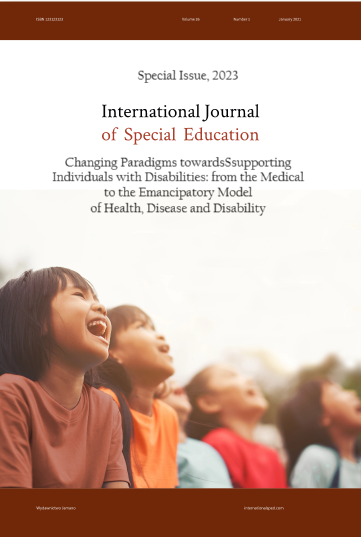
IJSE Vol 38, No: 3, 2023 - Special Issue
Vol. 38 No. 3 (2023)
Changing Paradigms Towards Supporting Individuals with Disabilities: from the Medical to the Emancipatory Model of Health, Disease and Disability - Special Issue